
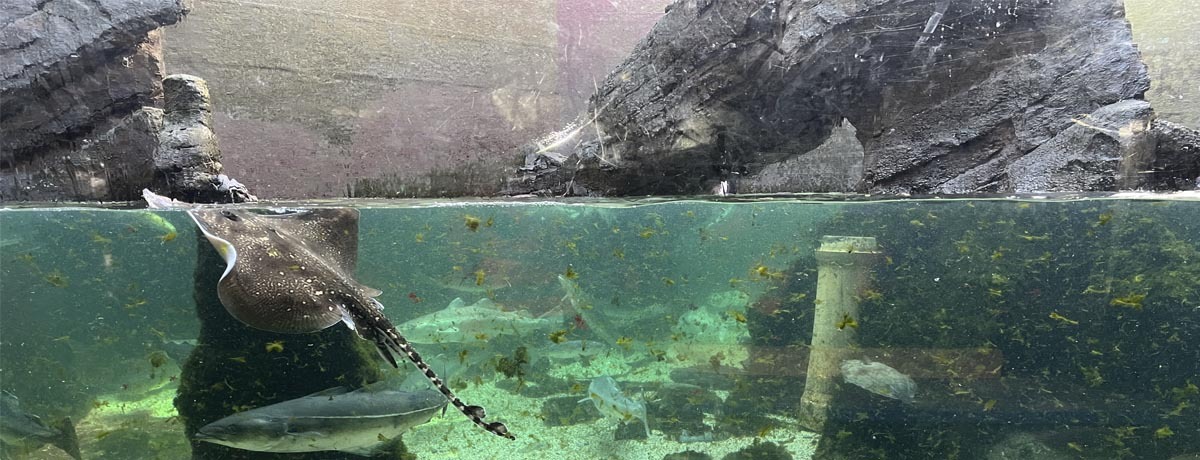
Draining the Kelp Reef Display
As part of the ongoing refurbishments at Macduff Aquarium, our main exhibit: the Kelp Reef display needed to be emptied for internal upgrades. This was a complex procedure involving all staff members, as well as many contractors, to allow the tank to be drained and cleared. Highest of priorities was the health and wellbeing of our resident kelp reef marine animals.
In the weeks leading up to Drain Day, we installed a backup tank in the car park which would provide temporary accommodation for some of our medium-sized animals, in addition to another cylinder tank around 5m across and 2 metres deep, to house the larger of our kelp reef residents.
Drain Day 1
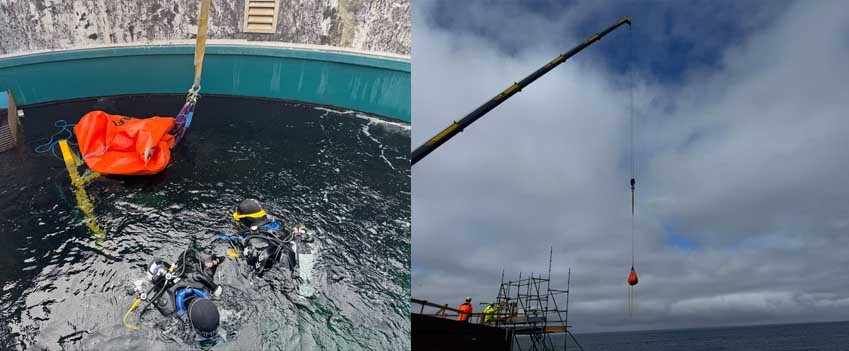
Drain Day itself started with the arrival of a 90 tonne crane which was chosen for its ability to position itself in the centre of the car park and allow the boom to reach not only the kelp tank, and swing round to the contingency tanks but also to be able to place a lifting bag into the shallows of the Moray Firth. This was important as we intended to release some of our residents as well as move the rest.
The aquarium team had designated roles: two divers in the kelp tank, a dive supervisor, two snorkellers, shore cover and runners. Firstly, the crane operators moved a lifting bag, very kindly supplied by Unique Group, into the main tank, whereupon the divers guided it to the bottom of the tank and encouraged one of our conger eels (nicknamed ‘Silver’ due to a patch of discolouration in the corner of one of her eyes) to swim inside. The bag was then closed and lifted out of the main tank and swung across to the sea just past the rocks where the snorkellers were able to open the bag and allow Silver to swim down into the kelp. This process was repeated for our second conger (‘Gold’).
Congers make an impressive migration as adults, swimming to the Azores, off Portugal, spawning once as they complete their lifecycle. Their young then drift in the plankton back up with the Gulf Stream and eventually settle round the UK coastline. Fingers crossed we’ll see some of Silver and Gold’s young back in the Moray Firth in a few years! We also took the opportunity to repeat the process and released a dozen of our adult thornback skate. We have had a few years of very successful thornback breeding within the aquarium and so wanted to release some of the adults into the wild.
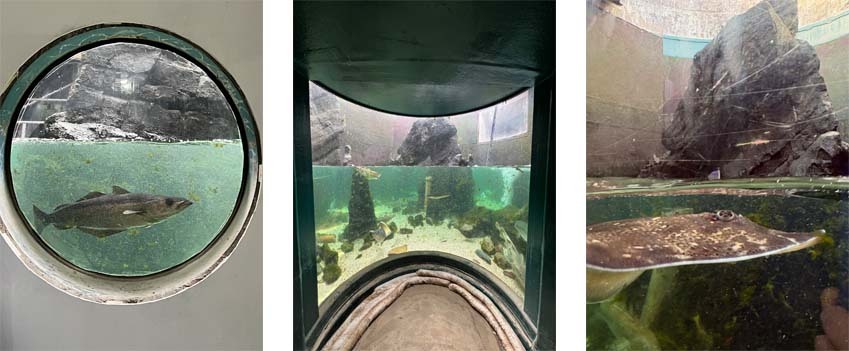
Once the releases had taken place, the snorkellers made their way to our temporary tanks ready to receive residents there. The divers moved any animals that were easily caught (it was important not to ‘chase’ the animals around the tank and cause them undue stress). This included the slower moving species such as our sharks (bull huss) and flatfish (turbot, halibut, plaice) and rarer species such as wolffish and bluemouths. It doesn’t sound a lot to do in one day, but around ten loads in total were moved on day 1 and it was decided to leave the rest to the following day.
Drain Day 2
The aquarist team made an early start as we needed to start the draining process of the kelp tank. This was a seemingly simple task of opening a valve to allow water to drain from the tank, but the process itself takes several hours. Some of our more active species, such as the gadoids (cod, pollack, saithe) and wrasse (cuckoo and ballan) would never be caught in the full tank, but with the water drained to thigh-depth, members of staff were able to climb into the tank via a 6m ladder, attached by the scaffolding team to our dive platform, and use nets to scoop the animals into large tubs which were then lifted out by crane to the temporary tanks. In this way, every fish, bar one, were removed safely from the tank.
‘What about the one?’ I hear you ask. Well, one of the smallest and prettiest fish in our tank, the female cuckoo wrasse, vanished during this process. She had been seen the day before Drain Day, so we knew she was still there somewhere, but where?! Thankfully, to perform the planned improvements within the tank, we had to clear the substrate from the bottom of the tank (by sweeping the fine gravel into piles and then shovelling into ton bags ready for craning out) and move the fake rockwork ‘pinnacles’ to enable this. It was whilst moving one of these pinnacles that a staff member caught a flash of movement from the corner of his eye: the female cuckoo wrasse had managed to squeeze into a crack in the fake rockwork, no wider than an inch, which had gathered water as a tiny pool. We managed to entice her out and put her safely into her temporary accommodation: a very lucky escape for the mischievous wrasse!
The kelp tank now sits empty and drying; it looks very different without water inside. Hopefully everyone will agree that the planned improvements will be worth all the hard work.
There are no items in this category.